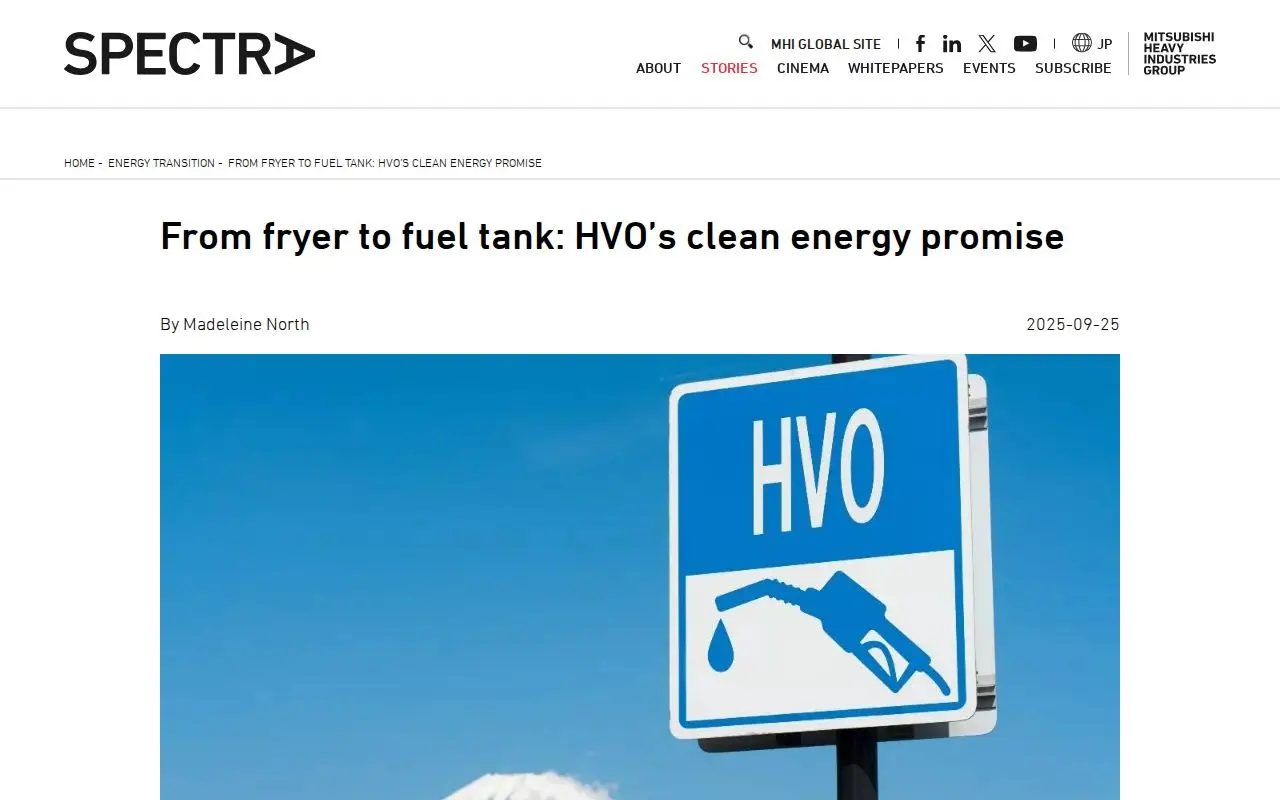
From fryer to fuel tank: HVO’s clean energy promise
SPECTRA by MHI@spectra
Seen in
Tech & routing
- Tech stack
- WordPress
- Language
- English
Landing page
Operated by
Company info pending
Landing page
spectra.mhi.com
1 page · final host: spectra.mhi.com
Tech stack
No third-party monetization stack detected — this appears to be a direct landing page.
Auto-summary
At a glance
Outbrain direct LP. Lead-gen / DTC. Running in 🇩🇪 Germany, 🇺🇸 United States. Active 3 days.
Landing page intelligence
spectra.mhi.com
Host
spectra.mhi.com
Path
/energy-transition/from-fryer-to-fuel-tank-hvos-clean-energy-promise
Full URL
Redirect chain
1 hop- finalspectra.mhi.com
Landing page snapshot

Captured 2026-05-15
Tracking parameters
- utm_source
- teads
- utm_medium
- display
- utm_campaign
- spectra_us
Tracking setup · Outbrain
Outbrain emits ob_click_id (your unique click), ob_source (publisher), ob_section (placement), and ob_position. Forward ob_click_id to your tracker as the postback key. ob_source and ob_section are the two highest-signal sub-IDs for blacklisting.
?ob_click_id={ob_click_id}&ob_source={ob_source}&ob_section={ob_section}&ob_position={ob_position}Default Outbrain setup template: ?ob_click_id={ob_click_id}&ob_source={ob_source}&ob_section={ob_section}&ob_position={ob_position}
Landing page text
Show landing page text
Visible text extracted from the advertiser's landing page · last fetched 2026-05-13
▶
Landing page text
Show landing page text
Visible text extracted from the advertiser's landing page · last fetched 2026-05-13
From fryer to fuel tank: HVO’s clean energy promise | Spectra by MHI
Skip to main content
ABOUT
STORIES
CINEMA
WHITEPAPERS
Events
SUBSCRIBE
ALL
Products & Services
Global News
Back
ABOUT
STORIES
CINEMA
WHITEPAPERS
Events
SUBSCRIBE
Header
MHI GLOBAL SITE
JP
MHI GLOBAL SITE
JP
MHI GLOBAL SITE
Breadcrumb
Home -
Energy Transition -
From fryer to fuel tank: HVO’s clean energy promise
By Madeleine North
2025-09-25
Index
1. Decarbonizing heavy transport
2. A cleaner solution for back-up power
3. Supporting sustainable agriculture
4. Liquid biofuels in shipping
5. Greening construction
Scaling supply and addressing feedstock challenges
When Doc Brown famously tossed banana peels and leftover beer into the DeLorean’s ‘Mr Fusion’ energy converter in Back to the Future , it was just a nice cinematic joke. Fast-forward to today and the concept of running vehicles and machines on food waste is no longer science fiction.
As governments, industries and consumers seek urgent solutions to decarbonize transport and off-grid power, hydrotreated vegetable oil (HVO) is emerging as a practical and scalable renewable diesel that could contribute meaningfully to the energy transition.
Produced by treating renewable feedstocks — such as used cooking oil, vegetable oil and animal fats — with hydrogen, HVO can reduce greenhouse gas (GHG) emissions by up to 90% compared to fossil diesel. Unlike many alternative fuels, it has the added advantage of being a ‘drop-in’ solution, meaning it can be used in existing engines and infrastructure without modification.
Below are five ways HVO is already helping to power the shift to lower-carbon energy systems — and the challenges that must be addressed to unlock its full potential.
1. Decarbonizing heavy transport
Heavy-duty vehicles — trucks, buses and long-haul fleets — are among the hardest to electrify due to their demanding energy needs, long ranges and the high cost and weight of batteries. Here, HVO offers a compelling alternative. Trucking fleets and public transport operators are increasingly turning to HVO to cut emissions without sacrificing reliability or performance.
A study in Bilbao, Spain, demonstrated that public buses running on HVO produced significantly lower CO 2 emissions in a dense urban environment. While Mitsubishi Heavy Industries (MHI) Group approved their diesel engines for HVO use in 2023 , part of the company’s trajectory to achieve net zero by 2040.
HVO is currently a more feasible alternative to diesel for heavy transport than electrification
2. A cleaner solution for back-up power
The explosion of data centers to manage our increasing reliance on generative AI has driven up demand for reliable backup power, traditionally supplied by diesel generators in places like hospitals and telecom infrastructure. HVO is now being adopted by companies like Amazon and Swedish company EcoDataCenter as a cleaner alternative, allowing these critical facilities to decarbonize their standby power without compromising reliability.
Data centers alone are projected to emit 2.5 billion tonnes of CO 2 -equivalent globally by 2030 if current trends continue. Transitioning to HVO for backup generation could significantly reduce these emissions, and companies across Europe are rapidly making the switch .
3. Supporting sustainable agriculture
Agriculture is both a major source of GHG emissions and a sector where electrification of machinery is often impractical due to cost, battery limitations and operational complexity.
In the European Union, agriculture accounts for 10% of total GHG emissions , with an additional 1% from fossil fuels used in machinery, according to the European Agricultural Machinery Association (CEMA). Alternative fuels like HVO can “play a key role in decarbonizing the agricultural sector, also in the short term by greening the existing fleet,” says CEMA.
4. Liquid biofuels in shipping
Maritime transport is responsible for around 3% of global emissions , yet the sector’s adoption of biofuels remains minimal. In 2023, shipping consumed just 0.7 million tonnes of oil equivalent (Mtoe) of liquid biofuels — less than 1% of its energy use.
HVO has the potential to help shipping companies meet tightening emissions regulations and is already the second-most widely used biofuel in the sector. Notably, the Golden Gate Ferry company in San Francisco, US, began trialing HVO in six of its ferries as early as 2019, signaling growing interest in the fuel for passenger shipping. However, uptake is constrained by limited supply, high production costs, compatibility issues and the need for new storage infrastructure.
Ferries in San Francisco, US, have been using HVO since 2019
5. Greening construction
Construction sites are traditionally powered by diesel-fueled machinery and generators, creating a significant carbon footprint. In the UK alone, the sector consumes around 2.5 Mtoe of diesel each year , powering around 300,000 pieces of machinery .
But HVO is increasingly being used for construction equipment, helping contractors reduce emissions and meet sustainability targets. The UK industry has set an ambitious target, reports the Construction Leadership Council: by the end of this year, 100% of the biofuels used on sites must be certified as sustainably sourced.
Scaling supply and addressing feedstock challenges
Despite its promise and the industries already utilizing the fuel, HVO faces barriers to wider adoption. Limited production capacity and high costs constrain supply, while concerns about land-use change, deforestation and food security complicate feedstock sourcing.
The renewable diesel market in the US is anticipated to keep growing. Source: US Energy Information Administration
The US HVO market is worth over $6.73 billion and around 3.1 billion gallons of biodiesel are produced annually. As a result, the country is rapidly expanding imports of animal fats and vegetable oils .
However, the increasing adoption of HVO globally is raising concerns about the use of virgin palm oil when there aren’t enough waste materials available.
Robust policy frameworks — such as the EU’s Renewable Energy Directive and the US’ Renewable Fuel Standard Program — are critical to ensuring that HVO delivers genuine climate benefits.
Production capacity is another challenge. The International Energy Agency estimates that liquid biofuel use, including HVO, must almost double by 2030 to stay on track for net zero. Achieving this will require new refineries, expanded supply chains and policies to close the cost gap with fossil fuels.
While no single solution will achieve net zero, HVO has the potential to be a reliable, flexible and low-carbon alternative that can help to accelerate the energy transition — and, of course, the DeLorean.
Discover more about sustainable data centers
Related tags
SHARE
#ENERGY TRANSITION
#Infrastructure
#Power & Energy
Madeleine North
Madeleine North has almost 30 years' journalism experience as a writer and editor for leading UK publications.
Articles by this author
STORIES
CINEMA
WHITEPAPERS
ABOUT
SUBSCRIBE
MHI GLOBAL SITE
MHI ENERGY TRANSITION
Go to the top of this page
TERM OF USE
PRIVACY POLICY
SUBSCRIBE
FOLLOW US :
© MITSUBISHI HEAVY INDUSTRIES, LTD.
Text scraped from the landing page for research purposes. © respective owners. This text is sourced from the advertiser's public landing page; for removal, contact dmca@luba.media.
Similar ads
Other creatives in Other on Outbrain
More from SPECTRA by MHI
What is CCUS and why is it key for the energy transition? | Spectra by MHI Skip…
Methane: Tackling a rising climate priority | Spectra by MHI Skip to main…
spectra.mhi.comThis is how AI is transforming the steel industry | Spectra by MHI Skip to main…
spectra.mhi.comWhy drones are vital to disaster relief | Spectra by MHI Skip to main content…
Powering Southeast Asia’s data center boom | Spectra by MHI Skip to main…