The Complete Parent’s Guide to Autism Rehabilitation
Physio Inq | Sponsored@physio
The ultimate resource for parents exploring holistic autism support options.
Top 25% longevity in network
Seen in
Tech & routing
- Language
- English
Landing page
Operated by
Company info pending
Operator graph
Operated by Physio Inq · runs 6 domains across 3 networks
Landing page
www.physioinq.com.au
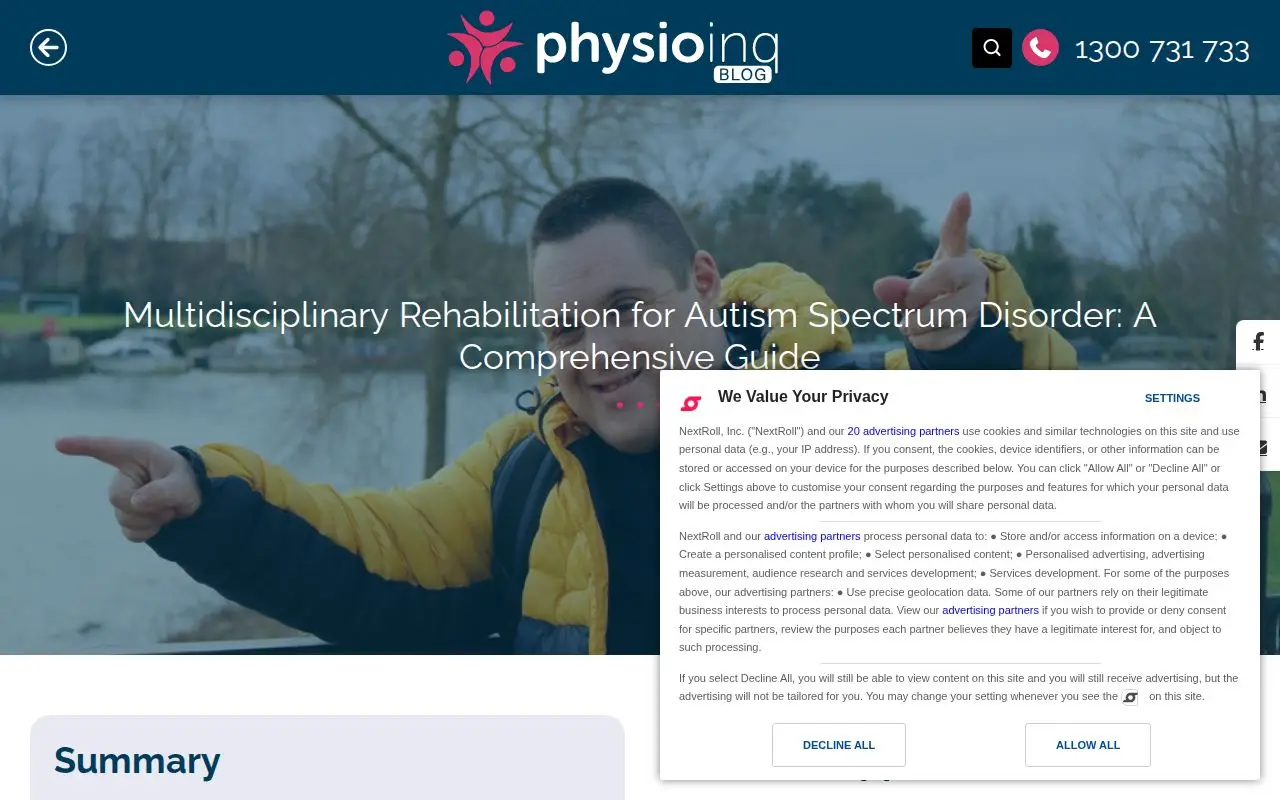
1 page · final host: www.physioinq.com.au
Tech stack
- MS Clarity
Auto-summary
At a glance
Outbrain direct LP. Lead-gen / DTC. Running in 🇦🇺 Australia. Active 21 days.
Landing page intelligence
physioinq.com.au
Host
physioinq.com.au
Path
/blog/multidisciplinary-rehabilitation-for-autism-spectrum-disorder-a-comprehensive-guide
Full URL
Redirect chain
1 hop- finalphysioinq.com.au
Landing page snapshot

Captured 2026-05-15
Tracking parameters
- obOrigUrl
- true
+ 1 known tracker hidden (cloaker IDs scrubbed at ingest).
Tracking setup · Outbrain
Outbrain emits ob_click_id (your unique click), ob_source (publisher), ob_section (placement), and ob_position. Forward ob_click_id to your tracker as the postback key. ob_source and ob_section are the two highest-signal sub-IDs for blacklisting.
?ob_click_id={ob_click_id}&ob_source={ob_source}&ob_section={ob_section}&ob_position={ob_position}Default Outbrain setup template: ?ob_click_id={ob_click_id}&ob_source={ob_source}&ob_section={ob_section}&ob_position={ob_position}
Landing page text
Show landing page text
Visible text extracted from the advertiser's landing page · last fetched 2026-05-13
▶
Landing page text
Show landing page text
Visible text extracted from the advertiser's landing page · last fetched 2026-05-13
Multidisciplinary Rehabilitation for Autism Spectrum Disorder: A Comprehensive Guide
🔍
1300 731 733
Multidisciplinary Rehabilitation for Autism Spectrum Disorder: A Comprehensive Guide
Summary
Explores research-backed benefits of a multidisciplinary rehabilitation approach for individuals with Autism Spectrum Disorder (ASD).
Emphasises how integrated care from a single organisation can streamline treatment and enhance outcomes.
Highlights key components including behavioural therapy, occupational therapy, speech pathology, and physiotherapy.
Focuses on empowering clients to achieve the best possible results through coordinated, client-centred care.
Provides high-quality external links to reputable Australian resources and research to support further learning.
Topics covered in this article:
Make an Appointment
For individuals and families navigating Autism Spectrum Disorder (ASD), accessing the right support can make all the difference. Multidisciplinary rehabilitation brings together experts from various fields, such as behavioural therapy, occupational therapy, speech pathology, and physiotherapy, to create a tailored, cohesive treatment plan. In this comprehensive guide, we explain why a multidisciplinary approach is essential, how it benefits clients, and why receiving all services from a single organisation can streamline care and optimise outcomes.
More Articles Related to NDIS Occupational Therapy
Role of Occupational Therapy in Forensic Mental Health
Discover More Articles
Role of Occupational Therapy in Forensic Mental Health
Discover More Articles
Understanding Autism Spectrum Disorder and the Need for Comprehensive Rehabilitation
What is Autism Spectrum Disorder?
Autism Spectrum Disorder is a developmental condition that affects communication, social interaction, and behaviour. The spectrum is broad, individuals may experience a wide range of challenges from sensory sensitivities to difficulties with social cues and repetitive behaviours. Early and ongoing intervention is critical to help maximise potential and support lifelong development.
Key Challenges in ASD
Social Communication Difficulties:
Many individuals with ASD experience challenges in initiating and sustaining conversations, interpreting social cues, and managing social interactions.
Sensory Processing Issues:
Over- or under-responsiveness to sensory input can cause discomfort and disrupt daily activities.
Behavioural and Cognitive Variability:
Differences in thinking and behaviour often require customised strategies for learning and adaptation.
Emotional Regulation:
Difficulty managing emotions may lead to heightened anxiety or frustration.
Understanding these challenges underscores the importance of a holistic rehabilitation program that addresses not only the core symptoms of ASD but also the broader impact on daily living.
More Articles Related to Disability & The NDIS
Physiotherapy for Kids on the NDIS
Discover More Articles
Physiotherapy for Kids on the NDIS
Empowering Movement: How Exercise Physiology Drives Independence for Individuals Living with Disability
Tailored NDIS Therapy: Finding the Approach That Works for You
Discover More Articles
The Advantages of a Multidisciplinary Approach
A multidisciplinary rehabilitation approach integrates various therapeutic disciplines to create a comprehensive, client-centred treatment plan. This method is particularly beneficial for individuals with ASD due to the complex, multi-faceted nature of the disorder.
Holistic Support:
By combining expertise from different fields, a multidisciplinary team addresses the diverse needs of individuals with ASD. This approach targets social, cognitive, emotional, and physical challenges simultaneously, leading to more balanced outcomes.
Personalised Treatment Plans:
Each person with ASD has unique strengths and challenges. A multidisciplinary approach allows for customised interventions that leverage individual abilities while addressing specific deficits.
Improved Coordination of Care:
When all services are delivered by a single organisation or through a closely coordinated team, care is more consistent and communication between professionals is seamless. This reduces fragmentation, ensures that treatment goals are aligned, and helps monitor progress more effectively.
Enhanced Outcomes:
Research shows that integrated rehabilitation can lead to better functional, social, and emotional outcomes. Clients benefit from a more structured and supportive treatment environment, which in turn fosters greater independence and improved quality of life.
More Articles Related to Paediatric Occupational Therapy
Easy Sensory Play Ideas for Children with Sensory Processing Disorder
Discover More Articles
Easy Sensory Play Ideas for Children with Sensory Processing Disorder
Assistive Technology for Elderly and Physically Disabled Individuals
Augmentative and Alternative Communication Devices for Non-Verbal Children
Discover More Articles
Core Services in a Multidisciplinary Rehabilitation Program
A comprehensive rehabilitation program for ASD typically includes a range of therapies that work together to enhance overall functioning:
1. Behavioural Therapy (e.g., Applied Behaviour Analysis - ABA)
Behavioural therapy focuses on teaching new skills and modifying challenging behaviours through structured, repetitive practice. It helps individuals with ASD learn adaptive behaviours and improve social interactions.
Benefits:
Enhances communication and social skills.
Reduces disruptive behaviours through positive reinforcement.
Builds a foundation for independent living.
Learn more about behavioural therapy for ASD at Autism Spectrum Australia (Aspect) .
2. Occupational Therapy
Occupational therapy helps individuals with ASD improve their ability to perform daily activities, from self-care to classroom tasks. Therapists tailor interventions to enhance sensory integration, fine motor skills, and overall functional independence.
Benefits:
Promotes independence in daily living.
Improves sensory processing and motor skills.
Supports participation in educational and social settings.
For more on occupational therapy, visit NDIS – Occupational Therapy .
3. Speech Pathology
Speech pathology services address communication challenges associated with ASD. These interventions focus on improving verbal and non-verbal communication, enhancing language skills, and supporting social interactions.
Benefits:
Improves clarity of speech and comprehension.
Supports the development of alternative communication methods if needed.
Enhances social participation and self-expression.
Learn more about speech pathology for ASD at Australian Speech Pathology Association .
4. Physiotherapy and Exercise Physiology
Physiotherapy and exercise physiology address physical challenges by improving strength, balance, and coordination. These therapies often incorporate fun, functional exercises that mimic everyday activities.
Benefits:
Enhances gross motor skills and physical endurance.
Improves balance and reduces the risk of falls.
Supports overall health and well-being.
Best Allied Health Disciplines to Assist
Choosing a single organisation that offers a full spectrum of services can streamline your rehabilitation journey. Here’s why working with one provider is beneficial:
Integrated Care:
Receiving services from the same organisation ensures that all therapies are coordinated. This integration leads to a unified treatment plan where each discipline complements the others, avoiding conflicting advice and treatment gaps.
Consistency and Communication:
Allied health professionals within one organisation can communicate seamlessly, ensuring that treatment goals are aligned and progress is monitored collectively. This cohesive approach results in more effective interventions and faster improvements.
Convenience and Accessibility:
In-home services provided by one organisation, such as our Mobile Physiotherapy and Occupational Therapy services, reduce the…
Text scraped from the landing page for research purposes. © respective owners. This text is sourced from the advertiser's public landing page; for removal, contact dmca@luba.media.
Similar ads
Other creatives in LeadGen on Outbrain
Speech Therapy for Toddlers: Early Intervention Strategies for Improved Communication
Sensory Integration Therapy for Children with Autism
Support Your Child’s Growth with Collaborative Therapy
How Movement Therapy Builds Independence With Disability
Watch Milestones Happen with NDIS-Backed Physio Sessions
More from Physio Inq | Sponsored
Speech Therapy for Toddlers: Early Intervention Strategies for Improved…
physioinq.com.auHow Can Occupational Therapy Help A Child With Autism? 🔍 1300 731 733 How Can…
physioinq.com.auSensory Integration Therapy for Children with Autism 🔍 1300 731 733 Sensory…
physioinq.com.auSensory Integration Therapy for Children with Autism 🔍 1300 731 733 Sensory…
physioinq.com.auCollaborative Care for Children with Developmental Delay: Speech Therapy and…
physioinq.com.auEmpowering Movement: How Exercise Physiology Drives Independence for…
physioinq.com.auPhysiotherapy for Kids on the NDIS 🔍 1300 731 733 Physiotherapy for Kids on…
physioinq.com.auNDIS Early Intervention Criteria: Is Your Child Eligible? 🔍 1300 731 733 NDIS…
physioinq.com.au