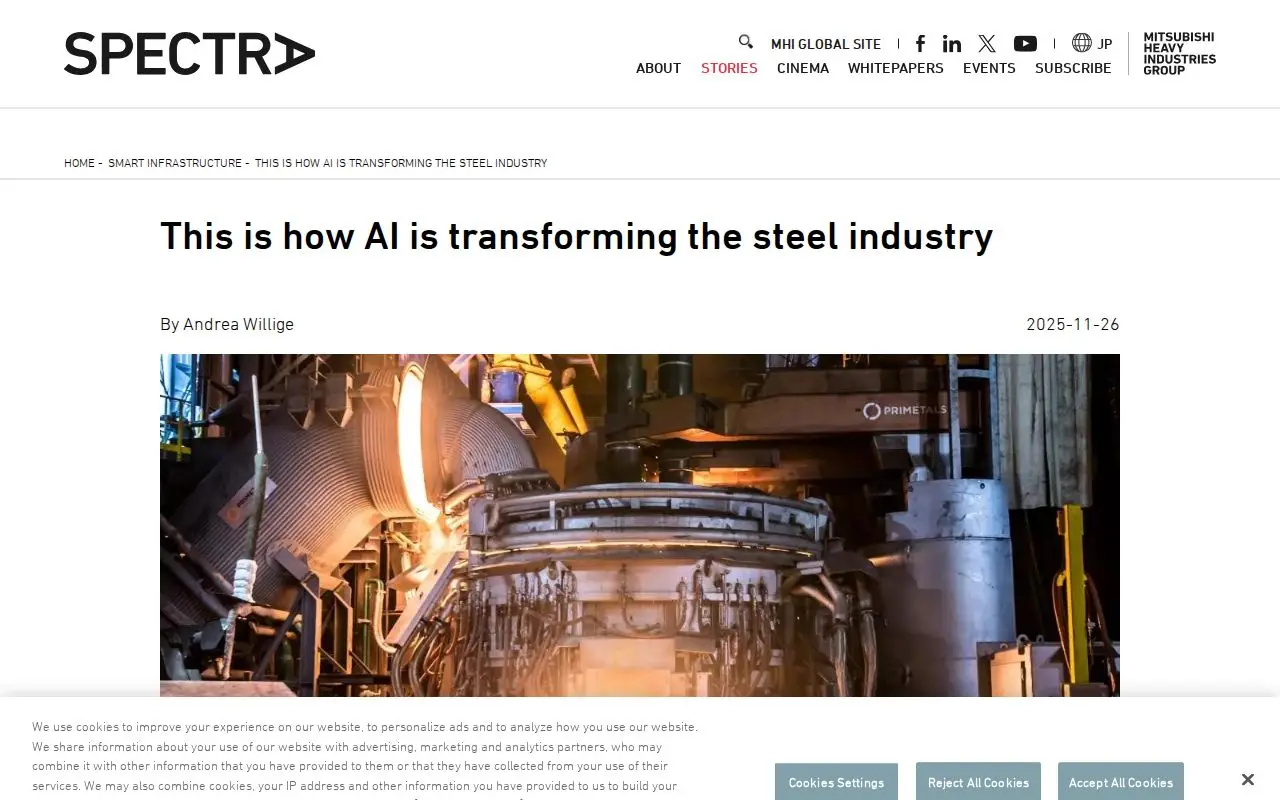
This is how AI is transforming the steel industry
SPECTRA by MHI | Sponsored@spectra
Seen in
Tech & routing
- Language
- English
Landing page
Operated by
Company info pending
Landing page
spectra.mhi.com
1 page · final host: spectra.mhi.com
Tech stack
No third-party monetization stack detected — this appears to be a direct landing page.
Auto-summary
At a glance
Outbrain direct LP. Lead-gen / DTC. Running in 🇺🇸 United States. Active 3 days.
Landing page intelligence
spectra.mhi.com
Host
spectra.mhi.com
Path
/smart-infrastructure/this-is-how-ai-is-transforming-the-steel-industry
Full URL
Redirect chain
1 hop- finalspectra.mhi.com
Landing page snapshot

Captured 2026-05-15
Tracking parameters
- utm_source
- teads
- utm_medium
- display
- utm_campaign
- spectra_us
- obOrigUrl
- true
+ 1 known tracker hidden (cloaker IDs scrubbed at ingest).
Tracking setup · Outbrain
Outbrain emits ob_click_id (your unique click), ob_source (publisher), ob_section (placement), and ob_position. Forward ob_click_id to your tracker as the postback key. ob_source and ob_section are the two highest-signal sub-IDs for blacklisting.
?ob_click_id={ob_click_id}&ob_source={ob_source}&ob_section={ob_section}&ob_position={ob_position}Default Outbrain setup template: ?ob_click_id={ob_click_id}&ob_source={ob_source}&ob_section={ob_section}&ob_position={ob_position}
Landing page text
Show landing page text
Visible text extracted from the advertiser's landing page · last fetched 2026-05-13
▶
Landing page text
Show landing page text
Visible text extracted from the advertiser's landing page · last fetched 2026-05-13
This is how AI is transforming the steel industry | Spectra by MHI
Skip to main content
ABOUT
STORIES
CINEMA
WHITEPAPERS
Events
SUBSCRIBE
ALL
Products & Services
Global News
Back
ABOUT
STORIES
CINEMA
WHITEPAPERS
Events
SUBSCRIBE
Header
MHI GLOBAL SITE
JP
MHI GLOBAL SITE
JP
MHI GLOBAL SITE
Breadcrumb
Home -
Smart Infrastructure -
This is how AI is transforming the steel industry
By Andrea Willige
2025-11-26
Index
Optimizing processes to reduce cost and emissions
Enhancing quality control
Toward more autonomous steel plant operations
Improving AI training
Metal making is one of the oldest manufacturing activities , going back to around 1800 BC, when the first smelted iron was made in India. More than 3,000 years later, steel mills became one of the symbols of the Industrial Revolution. Now, metal-making is facing a new revolution: the advent of Artificial Intelligence (AI).
Facing supply chain and cost pressures, an acute talent shortage and the gargantuan task of decarbonizing an inherently fossil-fueled industry, iron and steel makers have welcomed the advent of AI.
Dr Petra Krahwinkler, Senior Expert for AI at Primetals Technologies, a key supplier to the steel industry, explains that the technology can make a particularly strong impact in core areas such as process optimization, cost efficiency, CO 2 reduction and quality control. However, as AI continues to evolve, it also has the potential to change the industry more fundamentally.
Dr Petra Krahwinkler, Senior Expert for AI at Primetals Technologies
Optimizing processes to reduce cost and emissions
The production of iron – the base material for steel – involves highly complex processes that consume large amounts of energy.
These processes generate the high heat needed for steps such as sintering – where fine iron ore particles are fused into lumps to improve furnace efficiency – or smelting the ore in a blast furnace to extract pure iron.
Optimizing these processes and their interactions is essential, Krahwinkler argues: “We want to deploy just the right amount of heat and raw materials to achieve the required level of quality at the lowest cost and with the least amount of waste.”
Adjusting energy and material usage also makes the plant more energy and fuel-efficient, leading to lower CO 2 and greenhouse gas emissions and reducing pollutants in the working environment, including fine particulate matter, sulfur dioxide and nitrogen oxides.
Analyzing data from across the plant to establish the most efficient setup is crucial. And this is where AI can have a significant impact.
“By deploying AI’s vast data processing capabilities, we can analyze more – and much more complex — data from across the plant than a human ever could.” says Krahwinkler.
“We can also model and simulate the most efficient production routes and optimize energy management across the entire plant — from ore to finished product. This means that we can go closer to the limits without compromising on quality.”
AI can help model the most efficient production routes in metal-making
Enhancing quality control
AI can also enhance the many quality assurance stages of the metalmaking process, spotting issues or defects much earlier than a manual inspection could.
“In metal making, we rely a lot on taking samples. But these traditionally have to be sent off to the lab and their analysis can take quite some time,” explains Krahwinkler. “The advantage of AI is that it can do this analysis in real-time.”>
For example, in iron ore pelletizing or “greenballing,” AI-powered automated vision systems can automatically analyze the characteristics of the pellets produced, singling out those that don’t meet the requirements for size or shape. Based on this information, plant operators can then adjust the pelletizing process.
Similarly, there are digital assistant systems that use AI-based computer vision to monitor steel coils as they move through the plant, spotting surface defects that could lead to production delays or equipment damage.
“Rather than operators looking at vast amounts of monitoring data manually, these systems can guide them precisely to what they need to focus on, and they can adjust the process to ensure consistent product quality. This means less wastage, higher productivity and, by inference, cost savings and lower emissions,” Krahwinkler adds.
Human operators remain essential, but AI is evolving to take on more autonomous roles in plant operations
Toward more autonomous steel plant operations
Krahwinkler is excited about how much more AI-powered solutions could contribute to the evolution of metal making.
One area where she believes they could make a substantial difference is in modeling and simulation. Because of the complexity and uniqueness of steel plants, simulations typically take weeks to run.
That’s why Primetals Technologies is cooperating with Johannes Kepler University in Austria to develop AI-accelerated simulations that model the behavior of real production units. “Ideally, you want to specify the product characteristics and quality that you’re trying to achieve, and the system should tell you how to set the production parameters to reach that quality.”
Ultimately, this research aims to enable AI-powered systems to automatically adjust plant operations to achieve a perfect balance of inputs and outputs.
AI-powered computer vision systems can help steel mills maintain consistent quality
Improving AI training
Given the complexity of the materials and processes involved in metalmaking, traditional AI training is unable to achieve this.
“At the moment, an AI may detect new states outside its trained norms based on historic data. But that doesn’t necessarily indicate a problem; it could just be an acceptable variation. Human operators are still needed to make that decision at the moment.”
The team is working to combine “first principles” AI training and machine learning for more reliable predictions. Their research also explores "explainable AI" to help humans better understand AI conclusions.
“This will be vital as AI evolves to the next stage, moving toward more autonomous functions while supporting plant operations”, Krahwinkler concludes.
Discover more about MHI’s work in decarbonizing the steel industry
Related tags
SHARE
#SMART INFRASTRUCTURE
#Infrastructure
#Digitalization
#Power & Energy
Andrea Willige
Andrea Willige has spent many years creating content for the international business and technology press, working on behalf of some of the world’s largest technology companies.
Articles by this author
STORIES
CINEMA
WHITEPAPERS
ABOUT
SUBSCRIBE
MHI GLOBAL SITE
MHI ENERGY TRANSITION
Go to the top of this page
TERM OF USE
PRIVACY POLICY
SUBSCRIBE
FOLLOW US :
© MITSUBISHI HEAVY INDUSTRIES, LTD.
Text scraped from the landing page for research purposes. © respective owners. This text is sourced from the advertiser's public landing page; for removal, contact dmca@luba.media.
Similar ads
Other creatives in Other on Outbrain
More from SPECTRA by MHI | Sponsored
6 heat pump myths debunked | Spectra by MHI Skip to main content ABOUT STORIES…
spectra.mhi.com