Cash At Home - Rules Brits Might Want to Follow
Tasklifyhub@tasklifyhub
Seen in
Tech & routing
- Redirect chain
- 2 hops
- Language
- English
Landing page
Operated by
Company info pending
Landing page
tasklifyhub.com
1 page · final host: tasklifyhub.com
Tech stack
No third-party monetization stack detected — this appears to be a direct landing page.
Auto-summary
At a glance
Taboola direct LP. Lead-gen / DTC. Running in 🇬🇧 United Kingdom. Active 5 days.
Landing page intelligence
dx.tasklifyhub.com
Host
dx.tasklifyhub.com
Path
/f4a9c2e7-3d61-4b8a-a5c0-7e1d9c3a2f64
Full URL
https://dx.tasklifyhub.com/f4a9c2e7-3d61-4b8a-a5c0-7e1d9c3a2f64
Redirect chain
2 hops- hop 1dx.tasklifyhub.com
- finaltasklifyhub.com
Landing page snapshot
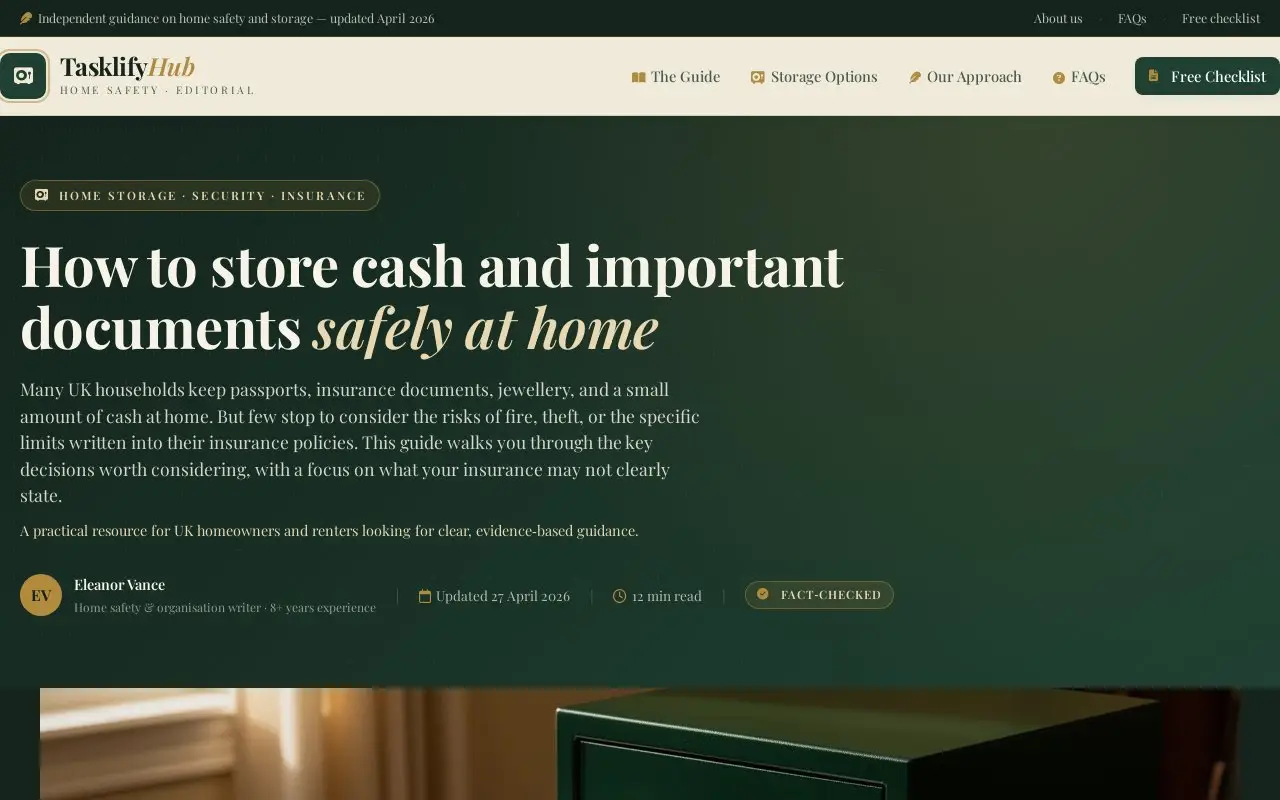
Captured 2026-05-14
Tracking parameters
No query string on this URL.
Tracking setup · Taboola
Taboola passes site, site_id, campaign_id, campaign_item_id and click-id by default. Map those to your tracker's source/sub1-4 fields. Use {click_id} as your unique click identifier when posting back conversions.
?site={site}&site_id={site_id}&campaign_id={campaign_id}&campaign_item_id={campaign_item_id}&click-id={click_id}Default Taboola setup template: ?site={site}&site_id={site_id}&campaign_id={campaign_id}&campaign_item_id={campaign_item_id}&click-id={click_id}
Landing page text
Show landing page text
Visible text extracted from the advertiser's landing page · last fetched 2026-05-12
▶
Landing page text
Show landing page text
Visible text extracted from the advertiser's landing page · last fetched 2026-05-12
How to Store Cash & Important Documents Safely at Home – A Practical UK Guide | Tasklify Hub
Skip to main content
Independent guidance on home safety and storage — updated April 2026
About us
·
FAQs
·
Free checklist
Tasklify Hub
Home Safety · Editorial
The Guide
Storage Options
Our Approach
FAQs
Free Checklist
The Guide
Storage Options
Our Approach
Reader Stories
FAQs
About
Free Checklist
Home Storage · Security · Insurance
How to store cash and important documents safely at home
Many UK households keep passports, insurance documents, jewellery, and a small amount of cash at home. But few stop to consider the risks of fire, theft, or the specific limits written into their insurance policies. This guide walks you through the key decisions worth considering, with a focus on what your insurance may not clearly state.
A practical resource for UK homeowners and renters looking for clear, evidence‑based guidance.
EV
Eleanor Vance
Home safety & organisation writer · 8+ years experience
|
Updated 27 April 2026
|
12 min read
|
Fact‑checked
Contents
What households store
Insurance sub‑limits
Cash & high‑value items
Storage methods
Certified safes
Fire vs. security
Document storage
Hiding places that fail
Digital backups
Our approach
Reader stories
About this site
FAQs
General information only. This article provides general guidance on home storage and household safety. It is not legal, financial, or insurance advice. Insurance terms vary significantly between providers, so you should always verify cover directly with your own insurer in writing before relying on it.
After a serious house fire, one of the most challenging tasks is often not the physical recovery, but proving what was lost. Birth certificates, passports, and insurance schedules destroyed in the flames can leave a family in administrative limbo for months. The practical steps that help prevent this outcome are neither expensive nor especially complicated. Most can be completed in a single quiet afternoon.
What UK households typically keep at home
The range of items kept in an ordinary UK household is often broader than people realise. When asked to list their possessions, the average homeowner frequently undercounts. Research by the Association of British Insurers has long shown that underinsurance – where the declared contents value sits well below true replacement cost – affects a meaningful proportion of UK policies. The shortfall rarely arises from dishonesty; it arises simply because people forget what they own.
The challenge splits into two distinct problems. Some items need protection against theft – jewellery, watches, cash, and small high‑value electronics. Others need protection from fire or water damage – paper documents, hard drives, and family photographs. A solution that handles one rarely handles both, which is why a single fireproof box is seldom enough on its own.
Items worth reviewing in your own home
Identity documents – passports (around £86 to replace in 2026), driving licences, birth and marriage certificates. Originals can take four to twelve weeks to reissue.
Financial records – mortgage deeds, bank statements, pension documents, and share certificates. Originals are often required for conveyancing or probate.
Insurance schedules – home, life, vehicle, and travel cover. If destroyed, you will need to contact each provider individually for duplicate paperwork.
Jewellery and watches – frequently underinsured because owners rely on a blanket contents figure rather than listing items individually with valuations.
Emergency cash – useful during power cuts or card‑system outages, but most standard policies cap cover at £200–£500 and require a locked container.
External drives and USB sticks – often hold photographs, business records, and tax data. Typically insured only at hardware value, not for the value of the data itself.
Spare keys – keys and property deeds discovered together during a burglary materially increase the risk of repeat entry. Store them separately.
Insurance sub‑limits – the small print that often catches people out
A home contents policy with a headline limit of £50,000 can still leave you significantly undercompensated. This is because most policies impose sub‑limits on specific categories. These figures rarely appear in the marketing summary; they are typically found in the policy schedule or the definitions section, where comparison sites do not always display them.
For a fuller breakdown of where these limits typically appear, please see our companion piece on reading a UK home insurance policy.
Typical sub‑limit ranges on standard UK home contents policies, 2026
Category Typical sub‑limit Common condition
Cash £200 – £500 Must be in a locked container
Single high‑value item £1,000 – £2,500 Items above threshold must be listed individually
Jewellery & watches (total) £5,000 – £10,000 Safe storage often required for a valid claim
Outbuildings (shed, garage) £2,500 – £5,000 Five‑lever lock or equivalent expected
Business equipment at home £1,000 – £2,500 Often excluded entirely from personal policies
Figures represent typical ranges across the UK market in 2026. Always confirm exact limits with your specific insurer.
Practical note. If your insurer requires high‑value items to be stored in a particular way – inside a Eurograde‑rated safe, for example – and a claim later arises without that condition being met, the claim may be refused in full, not merely reduced. This is a documented basis for refusal, not a theoretical risk. Always ask for any storage requirement in writing.
Cash and high‑value items – what the figures mean in practice
No UK law prevents you from keeping cash at home. Two legal frameworks become relevant only at the extremes. Under the Proceeds of Crime Act 2002, law enforcement may seize sums of £1,000 or more if criminal origin is suspected, with the burden of proof falling on the holder to demonstrate legitimacy. This is not a reason to avoid keeping ordinary household reserves – it simply illustrates why documented provenance matters for larger sums.
For jewellery and watches, the practical question is whether your current policy actually covers them. A ring with a replacement value of £3,500 is effectively uninsured if your policy's single‑article limit is £1,500 and the piece is not separately listed. Obtaining a written valuation from a registered jeweller and notifying your insurer is a straightforward administrative task – typically £50–£100 per item for the valuation itself.
£200–£500
Typical cash sub‑limit on standard UK home contents policies
177 °C
Temperature at which paper begins to char – the threshold fire‑resistant containers are rated to keep below
4–12 wks
Estimated wait to reissue a UK birth certificate; longer for documents from overseas registries
Storage methods – an honest comparison
The right choice depends on what you are protecting and what you are protecting it from. The table below offers a candid summary before each option is examined in detail.
Method Theft protection Fire protection Insurance effect
Hidden location (drawer, wardrobe) ✕ Minimal ✕ None No effect on cover
Fireproof document bag or box ! Low ✓ Good (paper) No effect on cash or jewellery cover
Locked filing cabinet (non‑Eurograde) ! Low ✕ None May not satisfy policy conditions
Eurograde 0 / non‑certified safe ! Moderate ✕ None May not meet Eurograde requirement
Eurograde 1 safe (installed) ✓ Strong ! Only if fire‑rated May raise cash & jewellery limits
Dual‑rated safe (security + fire) or safe + document pouch ✓ Strong ✓ Strong Best position for claim support
Certified safes – what Eurograde ratings actually mean
The Eurograde standard (EN 1143‑1) is the benchmark UK insurers refer to when specifying safe requirements. Each grade is awarded after independent attack testing at an accredited laboratory using a defined toolkit and time limit. The grade reflects what the testing concluded – not what the safe might withstand under every conceivable…
Text scraped from the landing page for research purposes. © respective owners. This text is sourced from the advertiser's public landing page; for removal, contact dmca@luba.media.
More from Tasklifyhub
How to Store Cash & Important Documents Safely at Home – A Practical UK Guide |…
dx.tasklifyhub.com