Skincare reviewer tests 127 lip glosses: here are the 3 that actually work
Beauty Review Magazine@beauty
Top 10% longevity in network
Seen in
Tech & routing
- Vendors
- Taboola widget
- Language
- English
Landing page
Operated by
Company info pending
Operator graph
Operated by Digital AdLabs OÜ · runs 1 domains across 1 networks
Landing page
beautyreviewmag.com
1 page · final host: beautyreviewmag.com
Tech stack
- Taboola widget
Auto-summary
At a glance
Taboola direct LP. Lead-gen / DTC. Running in 🇦🇹 Austria, 🇧🇪 Belgium, 🇧🇬 Bulgaria. Active 30 days.
Landing page intelligence
beautyreviewmag.com
Host
beautyreviewmag.com
Path
/tb-dermatologist-tests-142-anti-aging-creams-heres-his-1-pick/
Full URL
https://beautyreviewmag.com/tb-dermatologist-tests-142-anti-aging-creams-heres-his-1-pick/
Redirect chain
1 hop- finalbeautyreviewmag.com
Landing page snapshot
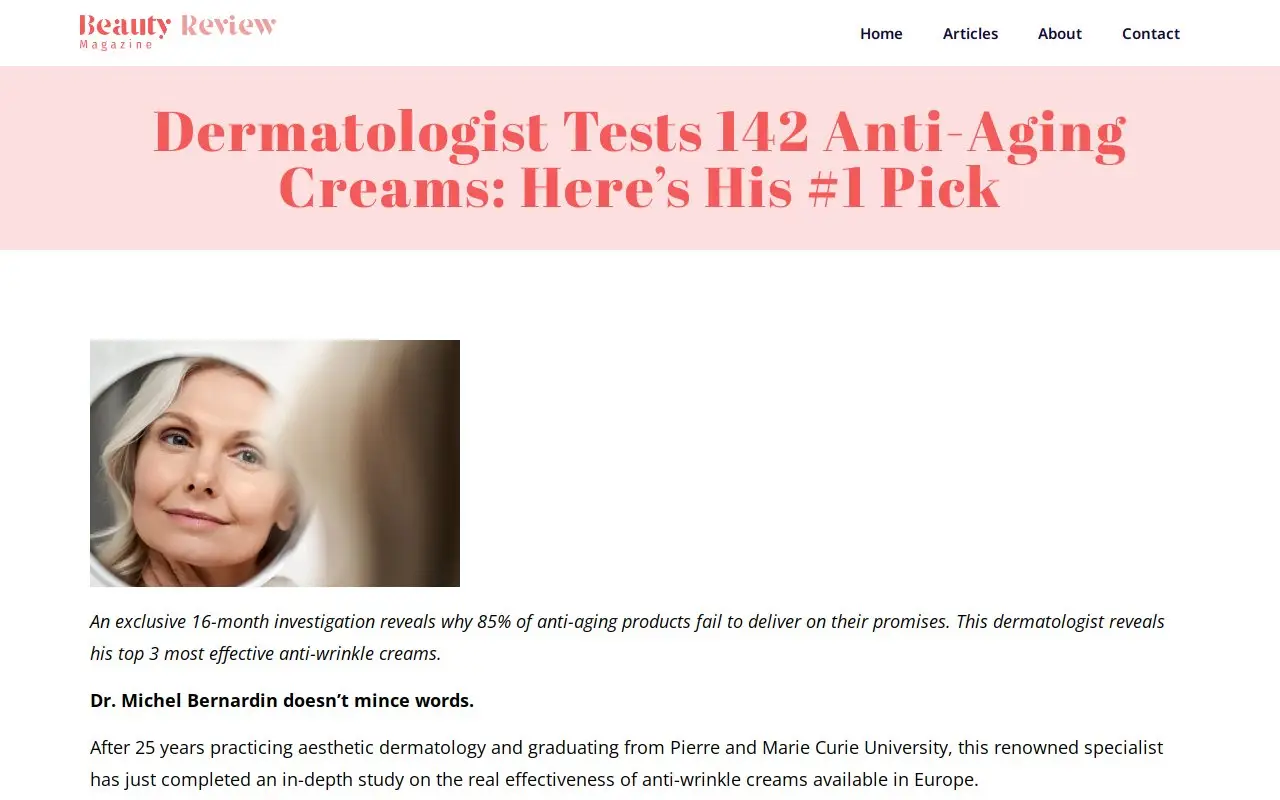
Captured 2026-05-15
Tracking parameters
No query string on this URL.
Tracking setup · Taboola
Taboola passes site, site_id, campaign_id, campaign_item_id and click-id by default. Map those to your tracker's source/sub1-4 fields. Use {click_id} as your unique click identifier when posting back conversions.
?site={site}&site_id={site_id}&campaign_id={campaign_id}&campaign_item_id={campaign_item_id}&click-id={click_id}Default Taboola setup template: ?site={site}&site_id={site_id}&campaign_id={campaign_id}&campaign_item_id={campaign_item_id}&click-id={click_id}
Landing page text
Show landing page text
Visible text extracted from the advertiser's landing page · last fetched 2026-05-12
▶
Landing page text
Show landing page text
Visible text extracted from the advertiser's landing page · last fetched 2026-05-12
Dermatologist Tests 142 Anti-Aging Creams: Here's His #1 Pick - Beauty Review Magazine
Skip to content
Home
Articles
About
Contact
Menu
Home
Articles
About
Contact
Dermatologist Tests 142 Anti-Aging Creams: Here’s His #1 Pick
An exclusive 16-month investigation reveals why 85% of anti-aging products fail to deliver on their promises. This dermatologist reveals his top 3 most effective anti-wrinkle creams.
Dr. Michel Bernardin doesn’t mince words.
After 25 years practicing aesthetic dermatology and graduating from Pierre and Marie Curie University, this renowned specialist has just completed an in-depth study on the real effectiveness of anti-wrinkle creams available in Europe.
His findings?
“The results are concerning for consumers.”
Insufficient concentrations of active ingredients. Excessive filler agents. Watered-down formulations. These are just some of the issues limiting the effectiveness of major brand anti-wrinkle creams.
Most importantly, he identified a little-known Irish product with an active ingredient concentration 4 times higher than the market average.
“The analysis revealed significant differences in formulations,” he notes. “Specialized brands, less constrained by the volume and margin pressures of large corporations, can afford more concentrated formulations of active ingredients.”
The Question That Started Everything
It all started two years ago.
“My patients regularly asked me the same question: how do you explain the price differences between anti-aging products? Is there really a noticeable difference between a €165 La Mer cream and a €32 pharmacy cream?” recalls Dr. Bernardin from his practice in Paris’s 16th arrondissement.
Faced with this recurring question, he decided to launch an investigation.
16 months of analysis. 142 products studied. 150 volunteers. A standardized evaluation protocol.
The results, validated by several independent laboratories, are revealing.
“More than 80% of the creams analyzed contain less than 3% active ingredients, well below the 5-8% recommended in scientific literature to observe clinical effectiveness.”
To illustrate the scope of this phenomenon, the dermatologist presents his analysis data.
“We observed considerable gaps between retail price and active ingredient concentration. A €82 Lancôme cream and a €26 L’Oréal cream showed comparable concentrations, around 2.5%.”
The numbers tell a stark story. You could be paying three times more for essentially the same formula.
A €11 Billion Market Under the Microscope
Dr. Bernardin’s investigation reveals the economic realities of a rapidly growing industry.
“Industry professionals confirm that marketing budgets often represent the largest portion of investments, sometimes at the expense of active ingredient research,” he observes.
A former L’Oréal formulator, speaking anonymously, testifies:
“We were given strict budget constraints on expensive ingredients like retinol or peptides to maintain profit margins. Rarely more than 2-3% total actives in a standard formula. The rest is mainly gelled water with preservatives, emulsifiers, and fragrance.”
She pauses, then continues.
“Then marketing develops attractive scientific names and stories around patented ingredients to justify the price differences. That’s the reality of the mass cosmetics industry.”
Independent laboratory analyses reveal a contrasting reality across 89 tested products:
64% contain less than 3% active ingredients (including certain products from Estée Lauder, Clinique, Clarins)
28% don’t exceed 2% (Vichy, La Roche-Posay, Avène)
Only 8% reach the 5-8% recommended by clinical studies
“When you pay €165 for a Crème de la Mer, you’re essentially paying for brand image. The active ingredient concentration isn’t fundamentally different from a €32 cream,” observes Dr. Bernardin.
His statement is backed by laboratory certificates. The proof sits in three-ring binders in his office. Anyone can verify it.
The Five Ingredients Science Actually Trusts
Analysis of international scientific literature helps identify molecules that have been the subject of documented clinical studies.
“Certain ingredients have a more solid body of research than others,” the dermatologist clarifies.
Syn-Ake: This synthetic peptide has been the subject of documented clinical studies. “It acts on certain mechanisms related to expression lines,” explains the dermatologist. A controlled study of 100 volunteers demonstrated a 52% reduction in wrinkles within 28 days at concentrations starting from 2.5%.
The key word here is “starting from.” Most creams contain far less.
Matrixyl 3000: This peptide complex stimulates collagen synthesis according to several scientific publications. “The University of Reading demonstrated that it doubles collagen production at dosages starting from 2%,” notes the specialist.
The study also revealed a 45% improvement in skin density and a 32% reduction in wrinkles after 2 months of use.
But here’s what matters. You need that 2% minimum. Anything less and you’re essentially rubbing expensive water on your face.
Stabilized retinol: “The gold standard ingredient in dermatology,” according to Dr. Bernardin. “You need a minimum of 0.5% to observe clinical effectiveness according to FDA studies.”
Research shows a 38% improvement in cell renewal and a 41% reduction in signs of photoaging after 12 weeks.
Dr. Bernardin keeps a chart on his wall. It shows how retinol effectiveness drops dramatically below the 0.5% threshold. The curve is almost flat at 0.1%.
That’s the concentration in most drugstore retinol creams.
Grant-X: This elastomer technology offers a temporary smoothing effect. “The manufacturer’s studies show a visible effect starting from 4% concentration.”
Clinical tests: 50% reduction in wrinkle appearance within 10 minutes and 35% improvement in skin texture immediately after application.
“The problem is that most commercial creams dose these ingredients well below effective thresholds,” emphasizes Dr. Bernardin. “We find Syn-Ake at 0.05% in certain Olay products, retinol at 0.1% in Neutrogena.”
He pulls out a spreadsheet.
Column after column of brand names. Next to each one, the actual active ingredient percentages. The numbers are surprisingly low.
“This is what your money is really buying,” he says.
How The Testing Actually Worked
Dr. Bernardin implemented a standardized analysis protocol.
“Each product was tested over a 10-week period with a panel of 150 volunteers aged 32 to 68,” he details.
The measurements used professional skin analysis equipment:
Cutometer SEM 575 to measure elasticity
Visiometer SV600 to analyze surface roughness
Dermascan C with 20MHz ultrasound for tissue thickness
These aren’t subjective opinions. These are machine readings. The same equipment used in clinical trials for pharmaceutical companies.
Every volunteer was photographed under standardized lighting. Their skin was measured at the exact same spots. Week after week. For ten weeks straight.
“We created a database of over 15,000 individual measurements,” Dr. Bernardin explains. “This level of rigor is rarely seen outside university research.”
The volunteers themselves were surprised by the results. Many had been using expensive creams for years. They assumed they were working.
The measurements told a different story.
Three Products Stand Out with High Concentrations
Among the 142 products analyzed, three display active ingredient concentrations above 10%.
“These formulations completely break from the usual market standards,” observes Dr. Bernardin. “Thanks to their high actives concentration, their ability to reduce wrinkles and create a youthful glow is significantly greater than mass-market products.”
The scientific explanation is straightforward.
“Our analyses show that between 3% and 8% actives, effectiveness progresses linearly. Beyond 10%, we observe an exponential effect on measured results.”
The concentration breakthrough speaks for itself.
“The data is crystal clear,” explains the dermatologist.…
Text scraped from the landing page for research purposes. © respective owners. This text is sourced from the advertiser's public landing page; for removal, contact dmca@luba.media.
Similar ads
Other creatives in Content Arb on Taboola
More from Beauty Review Magazine
Dermatologist Tests 142 Anti-Aging Creams: Here's His #1 Pick - Beauty Review…
The Twin Sister Study That's Changing How We Think About Aging - Beauty Review…