The SR-71 Blackbird Can’t Run on Jet Fuel. Here’s What It Uses Instead.
Seen in
Tech & routing
- Tech stack
- WordPress
- Language
- English
Landing page
Operated by
Company info pending
Landing page
nationalinterest.org
1 page · final host: nationalinterest.org
Tech stack
- Outbrain widget
Auto-summary
At a glance
Outbrain direct LP. Lead-gen / DTC. Running in 🇺🇸 United States. Active 2 days.
Landing page intelligence
nationalinterest.org
Host
nationalinterest.org
Path
/blog/buzz/sr-71-blackbird-cant-run-on-jet-fuel-heres-what-it-uses-instead-hk-050426
Full URL
Redirect chain
1 hop- finalnationalinterest.org
Landing page snapshot

Captured 2026-05-14
Tracking parameters
- utm_source
- {{publisher_id}}
- utm_medium
- obbow
- utm_campaign
- 005d12752089d1ab57e826153f8bf1e752
- utm_adtitle
- The+SR-71+Blackbird+Can’t+Run+on+Jet+Fuel.+Here’s+What+It+Uses+Instead.
Tracking setup · Outbrain
Outbrain emits ob_click_id (your unique click), ob_source (publisher), ob_section (placement), and ob_position. Forward ob_click_id to your tracker as the postback key. ob_source and ob_section are the two highest-signal sub-IDs for blacklisting.
?ob_click_id={ob_click_id}&ob_source={ob_source}&ob_section={ob_section}&ob_position={ob_position}Default Outbrain setup template: ?ob_click_id={ob_click_id}&ob_source={ob_source}&ob_section={ob_section}&ob_position={ob_position}
Landing page text
Show landing page text
Visible text extracted from the advertiser's landing page · last fetched 2026-05-12
▶
Landing page text
Show landing page text
Visible text extracted from the advertiser's landing page · last fetched 2026-05-12
The SR-71 Blackbird Can’t Run on Jet Fuel. Here’s What It Uses Instead. - The National Interest
About Us
Submissions
Advertising
Support Us
The National Interest logo
Blogs
Back
The Buzz
Energy World
Korea Watch
Middle East Watch
Silk Road Rivalries
Techland
US Politics
Podcasts
Back
Divergences
In The National Interest
Russia Decoded
Three Questions
Regions
Back
Africa
Antarctic
Arctic
Asia
Central America
Europe
Eurasia
Middle East
North America
Oceania
South America
Military
Back
Gaza War
Iran War
Ukraine War
Air Warfare
Land Warfare
Naval Warfare
Nuclear Warfare
Military Administration
Politics
Back
2026 Elections
Donald Trump
JD Vance
Congress
Diplomacy
Technology
Back
Artificial Intelligence (AI)
Cryptocurrency
Cybersecurity
Digital Infrastructure
Robotics
Space
About Us
Submissions
Advertising
Support Us
Search...
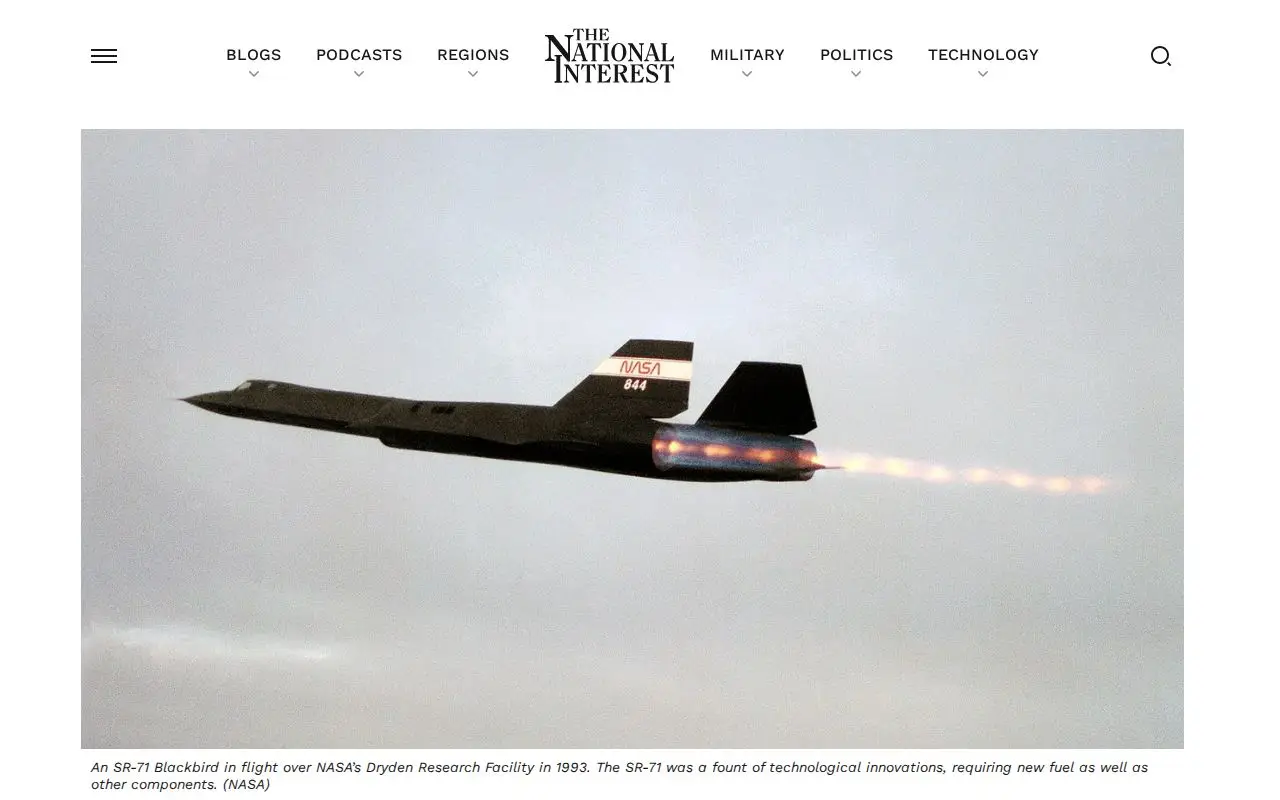
An SR-71 Blackbird in flight over NASA’s Dryden Research Facility in 1993. The SR-71 was a fount of technological innovations, requiring new fuel as well as other components. (NASA)
Topic: Air Warfare
Blog Brand: The Buzz
Region: Americas , and North America
Tags: Aircraft , JP-7 , NASA , Spy Planes , SR-71 Blackbird , United States , and US Air Force
The SR-71 Blackbird Can’t Run on Jet Fuel. Here’s What It Uses Instead.
May 4, 2026
By: Harrison Kass
Share
Share this link on Facebook
Share this page on X (Twitter)
Share this link on LinkedIn
Share this page on Reddit
Email a link to this page
Ordinary jet fuel would boil and combust inside the Blackbird’s fuel tanks—meaning the aircraft must use a special fuel blend that is nearly impossible to light by accident.
The SR-71 Blackbird remains the fastest aircraft ever built. Operated from 1966 to 1999, it was a renowned reconnaissance aircraft that could exceed Mach 3 and altitudes of 80,000 feet. It had incredible kinetic performance metrics, setting speed records that are likely never to be broken by any manned aircraft.
But the Blackbird’s incredible performance created problems. At such speed and altitude, the jet’s skin temperature could exceed 500 degrees Fahrenheit. And at such temperatures, traditional jet fuel was too volatile—too likely to vaporize, ignite, or break down under the extreme heat. So the SR-71’s designers were tasked with creating an entirely new fuel ecosystem, something that could handle the SR-71’s envelope-pushing performance.
The SR-71 Blackbird Was Literally Too Fast for Jet Fuel
Standard jet fuels are designed for ordinary subsonic or supersonic aircraft—not for the thermal loads of sustained Mach 3 flight. The SR-71 created a heating problem; air friction would heat the airframe far more quickly than a slower aircraft. The airframe contained the fuel tanks, which would also heat up. Had the tanks been filled with ordinary jet fuel, the vapor pressure would have quickly risen too high, boiling the fuel inside and creating dangerous vapors. The only solution was to develop a brand-new fuel from scratch—one that would remain stable even at extreme temperatures, and would not ignite accidentally but still burn reliably when needed.
The solution was a new fuel blend called JP-7 . With low volatility and an extremely high flashpoint, JP-7 had the thermal stability and resistance to vaporization necessary to enable SR-71 operations. In practice, what this means is that JP-7 is hard to ignite, meaning it was safe inside the extremely hot SR-71 structure.
The tradeoff was that, because JP-7 was so stable, it was difficult to light in the first place. Famously, some developers claimed that a lit match dropped directly into a puddle of JP-7 would not ignite it. Regardless of whether this was actually true or not, JP-7 functioned less like ordinary aviation fuel and more like an engineered thermal-management fluid that also happened to power the aircraft.
Interestingly, JP-7’s remarkable stability also meant that it could be used as a coolant . While the Blackbird was in flight, the fuel was circulated through hot areas of the aircraft, cooling the hydraulic fluid, oil, avionics, and engine components. No ordinary cooling system could handle Mach 3 heat as efficiently—meaning the fuel system was part of the jet’s thermal protection system.
How Do You Light a Fuel That Won’t Burn?
The challenge, of course, was igniting the JP-7 in the first place. The solution was triethylborane (TEB), which ignites spontaneously on contact with air, producing a distinctive green flash during engine start or afterburner engagement. TEB was used for the SR-71’s engine start and afterburner ignition. Interestingly, the aircraft did not carry its own ignition; in order to start its engines, it needed the help of a “start cart” on the ground—usually consisting of two Buick engines combined together.
JP-7 speaks to the remarkable ingenuity and inventiveness that was required to get the SR-71 operational. The performance envelope was so extreme, the kinetic metrics so unrivaled, that new technologies were needed at a granular level just to make the project feasible, including a specialized low volatility fuel source.
Of course, this complicated logistics and operations (for example, specialized KC-135Qs were needed to carry JP-7), making the SR-71 prohibitively expensive to operate—part of why the jet was ultimately retired . But its three decades of service, and the dozens of airspeed records it set, were a testament to the ingenuity and hard work of America’s aircraft designers and pilots.
About the Author: Harrison Kass
Harrison Kass is a writer and attorney focused on national security, technology, and political culture. His work has appeared in City Journal, The Hill, Quillette, The Spectator, and The Cipher Brief. He holds a JD from the University of Oregon and a master’s in Global & Joint Program Studies from NYU. More at harrisonkass.com .
The National Interest logo
Stay in the know with
The National Interest newsletter
* indicates required
Email Address *
Connect
About Us
Submissions
Advertising
Careers
Support Us
Topics
Climate
Diplomacy
Environment
Human Rights
Manufacturing
Trade
Regions
Africa
Americas
Antarctic
Arctic
Asia
Europe
Eurasia
Middle East
Oceania
© Copyright 2026 Center for the National Interest . All Rights Reserved.
Privacy Policy
Terms & Conditions
Masthead
Text scraped from the landing page for research purposes. © respective owners. This text is sourced from the advertiser's public landing page; for removal, contact dmca@luba.media.
More from The National Interest
Adapt or Die: The US Army Needs a Better Self-Propelled Howitzer - The National…
nationalinterest.orgWhy Is Germany Buying Up More Eurofighter Aircraft? - The National Interest…
nationalinterest.orgBoeing Made a ‘Digital Twin’ of the B-52 Stratofortress - The National Interest…
nationalinterest.org